
If you’ve been backing off activity to protect your aching joints, you may be doing more harm than good. Here’s the truth about chronic joint pain — and the smarter approach that actually works.
You wake up stiff. Your knees ache on the stairs. Your hips tighten after sitting too long. And every time you try to do something about it — a walk, a light workout — you flare up and land back at square one.
So you rest. Because that’s what makes sense, right?
Here’s the uncomfortable truth: for most people dealing with chronic joint pain, rest is not the answer. In many cases, it’s the very thing keeping them stuck. This post breaks down exactly why that happens, and what to do instead — so you can start moving again, safely and sustainably, without the fear of making things worse.
The Biggest Mistake People Make With Joint Pain
It feels responsible. It feels careful. When something hurts, you stop doing it — that’s basic survival instinct.
And for certain injuries, rest absolutely has a role. A fresh tear, a fracture, an acute flare — these need time and recovery. But for the kind of chronic joint pain most people deal with — the ongoing stiffness, the nagging aches that are always kind of there — prolonged rest is one of the worst things you can do.
Here’s why.
When you stop moving, your muscles weaken. When your muscles weaken, they stop supporting your joints properly. When joints lose that muscular support, every movement puts more stress directly on the joint itself. More stress means more pain — which makes you want to rest more — which weakens the muscles further — which creates even more pain.
This is the pain loop. And the longer you’re in it, the harder it becomes to escape.
There’s another layer to this that most people don’t know: your joints don’t have their own direct blood supply the way muscles do. They get their nutrients from the synovial fluid inside the joint — and that fluid only circulates when you move. Stop moving, and your joints are literally being deprived of the nutrition they need to stay healthy. Movement restores that circulation. Rest starves it.
What’s Actually Causing the Pain
To fix something, you have to understand what’s going wrong. So let’s talk about what’s really happening inside a painful joint.
Your knees, hips, and shoulders aren’t designed to work alone. They’re protected and stabilised by the muscles and tendons surrounding them. Think of your muscles as shock absorbers — they’re supposed to take on load, absorb impact, and keep the joint stable through everyday movement.
When those muscles are strong and active, your joints barely register the stress of going up stairs, standing from a chair, or walking across a car park. But when those muscles are weak? All of that load transfers directly onto the joint. The cartilage, tendons, and joint capsule start taking hits they were never designed to handle — and over time, that adds up.
Think of it like carrying a heavy backpack. With a strong core and good posture, you barely notice it. Slouched and exhausted, that same weight feels crushing. Your joints work exactly the same way.
Add in the circulation problem from lack of movement, and you’ve got a double hit: joints not getting proper nutrition, being overloaded with stress, surrounded by muscles that have weakened from disuse. That sounds discouraging — but it’s actually a very fixable situation. Because the root cause responds well to the right kind of movement.
Why Exercise Feels So Impossible to Stick To

If movement is the answer, why is it so hard to actually do it?
It’s not laziness. It’s not weakness. There are real, understandable reasons people with joint pain struggle to stay consistent — and none of them are your fault.
Fear of making it worse. You’ve tried before and paid for it. A long walk that left you limping for days. A workout class that wrecked you for a week. After that happens a few times, your brain starts treating exercise as a threat — and that’s a completely rational response. It just keeps you stuck.
Doing the wrong kind of exercise. Many people try to return to fitness with high-impact activities — running, jumping, intense cardio classes. These aren’t inherently bad, but for someone with joint pain and muscle weakness, they’re too much too soon. They almost guarantee a flare-up, which confirms the fear, which makes the next attempt even harder.
Loss of trust in your own body. After months or years of pain and setbacks, you stop believing your body will cooperate. You don’t know what’s safe. You don’t know where your limits are. So rather than risk getting it wrong, you don’t try at all.
The stop-start cycle. You feel better, you do too much, you flare up, you rest, you lose ground. Each time the cycle repeats, it feels more impossible to break.
Every one of these obstacles is real — and every one of them has a solution. The answer isn’t willpower or pushing harder. It’s having the right framework: one that works with your body instead of against it.
The Shift: From Less Movement to Better Movement
Here’s the reframe that changes everything.
The goal is not less movement. The goal is better movement.
For a long time, you may have thought about exercise in terms of intensity — go hard or go home. But that’s the wrong lens entirely when it comes to joint pain. What your joints actually need isn’t intensity. It’s consistency. Controlled, purposeful movement that gradually rebuilds the strength and mobility your body has lost — without triggering the pain loop that keeps setting you back.
This approach — call it smart movement — isn’t a special programme or a magic routine. It’s a way of approaching movement that meets your body where it actually is right now, and builds from there. Low intensity, high frequency. Strength-focused before cardio-focused. Small wins that stack up into something significant over time.
And here’s the part that surprises most people: you can start even on days when you’re hurting. Because the right kind of movement often makes pain better, not worse. You don’t have to wait until you feel good to begin. You begin — and that’s what helps you feel good.
How to Start Moving Again: 5 Practical Steps
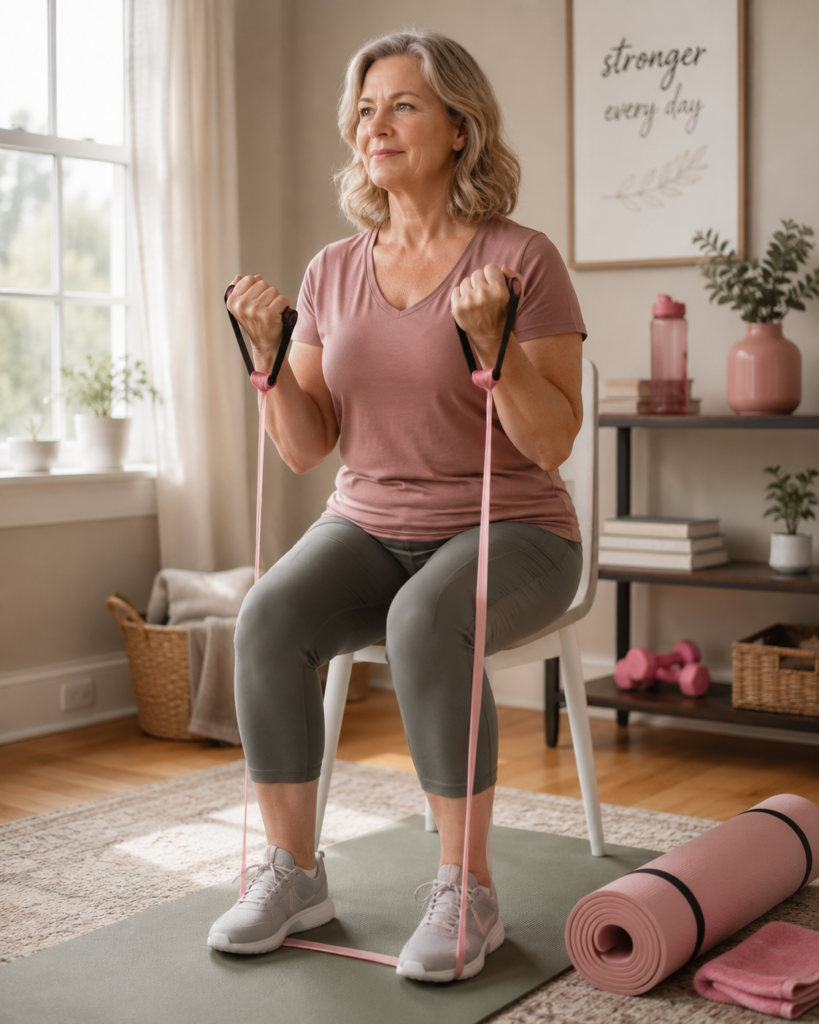
Step 1: Daily Low-Intensity Movement — Every Single Day
Not an hour-long workout. A short walk. Some gentle range-of-motion movements. A few minutes of light activity in the morning to ease the stiffness.
Every day — not when you feel like it. Every day.
Consistency matters far more than intensity at this stage. You’re retraining your nervous system, rebuilding trust with your body, and keeping your joints properly nourished. Even ten minutes counts. Even five is better than nothing.
Step 2: Prioritise Strength Over Cardio
Cardio feels productive, but building strength around the joint is far more impactful for pain. You don’t need heavy weights. Bodyweight exercises — chair squats, wall sits, glute bridges, calf raises, resistance band work — are incredibly effective. The goal is to wake up the muscles that have gone quiet from disuse and get them supporting your joints again.
Start with two or three exercises. Keep the reps low. Focus on form, not effort.
Step 3: Start Smaller Than You Think You Should
This is the one people resist most — and the most important.
If you think you can do ten reps, do six. If you think you can walk for twenty minutes, walk for ten. Starting smaller than your current capacity means you finish feeling good, not wrecked. No flare-ups. And you can do it again tomorrow. That’s the whole game: showing up again tomorrow.
Step 4: Know the Difference Between Good Discomfort and Bad Pain
Some discomfort during exercise is normal. Muscles working, mild achiness during movement — that’s your body adapting. What you want to avoid is sharp, sudden pain, or pain that significantly worsens during or after exercise.
A simple guide:
- Green: Mild discomfort — keep going.
- Yellow: Moderate achiness that settles quickly — proceed carefully.
- Red: Sharp, stabbing, or escalating pain — stop and reassess.
This framework alone will help you exercise more confidently, because you’ll stop second-guessing every sensation.
Step 5: Consistency Over Perfection
You will miss days. You will have bad weeks. Your pain will fluctuate. That is normal and it does not mean you’ve failed.
The only way this stops working is if you quit entirely. A bad week followed by getting back on track is just called progress. Focus on building a streak of good enough days — not a perfect record. Over weeks and months, those days compound. The strength adds up. The pain becomes more manageable. The fear fades.
Common Mistakes That Derail Progress
Even with the best intentions, it’s easy to fall into these traps:
Waiting until the pain is completely gone. If you wait for zero pain before starting, you may be waiting forever. The movement itself is part of what reduces the pain. Start smart — not pain-free.
Going too hard too soon. You feel a bit better, you get motivated, you go all in — and you’re wiped out for a week. This is the most common reason people quit. Moving at the right pace feels slow, but it’s real and sustainable.
Only stretching and never strengthening. Flexibility is valuable. But stretching alone doesn’t build the muscular support your joints need. If your entire routine is stretching, you’re only solving half the problem.
Quitting too early. Lasting change in your joints and muscles takes weeks, sometimes months. Five days without dramatic improvement doesn’t mean it’s not working. Give your body the time it needs. The results come — just not linearly, and not as fast as we’d like.
You’re Not Too Far Gone
Your pain is real. Your frustration is valid. And struggling doesn’t mean you’re doing something wrong — it means no one has given you the right roadmap yet.
You are not too old. You are not too far gone. Your body has not given up on you. It’s simply waiting for the right input. Movement is that input — not brutal, punishing exercise, but smart, consistent, progressive movement that meets your body where it is and builds steadily from there.
Start small. Stay consistent. Trust the process.
Ready to Take the Next Step?
Knowing what to do is one thing — having a clear plan to follow is another. If you want something concrete to work from, I’d recommend starting with a structured, joint-friendly programmed rather than piecing things together on your own. That’s exactly the kind of approach covered in this free 6-week guide, which walks women 50+ through rebuilding strength gradually, without the workouts that tend to trigger flare-ups or set you back.
It’s free, it’s straightforward, and it’s a solid place to begin.
If this post resonated with you, feel free to share it with someone who needs to hear it — or leave a comment below. I’d love to know where you’re at and what’s been hardest for you.
You’ve got this.

Hi, this is a comment.
To get started with moderating, editing, and deleting comments, please visit the Comments screen in the dashboard.
Commenter avatars come from Gravatar.