
Here’s something nobody talks about enough: for people living with joint pain, the advice to “just exercise more” can feel downright cruel.
You want to move. You know movement is supposed to be good for you. But every time you try — whether it’s a walk around the block, a beginner workout video, or even climbing a flight of stairs — your knees, hips, or joints flare up, and you’re back to square one. Sore, frustrated, and no closer to feeling better.
That cycle is exhausting. And if you’ve been stuck in it, I want you to know something important: it’s not your fault, and you’re not broken. You’ve just been given the wrong starting point.
“Movement is medicine — but only when the dose is right. For joint pain, that means starting gentle, staying consistent, and building slowly.”
The truth is, your body doesn’t need punishing workouts to heal and get stronger. It needs the right kind of movement — low-impact, intentional, and appropriate for where you are right now. That’s exactly what this guide is about.
Below, you’ll find 5 of the most effective beginner-friendly movements for people dealing with joint stiffness, chronic aches, or general mobility issues. They’re simple, they require no equipment, and they can be done at home — starting today.
The Low-Impact Explanation
Before we get into the exercises, let’s clear something up. When we talk about low-impact exercise for joint pain, we’re not talking about “easy” or “lazy” movement. We’re talking about movement that minimises stress on the joints while still improving circulation, mobility, and strength.
High-impact activities — running, jumping, heavy lifting — put significant force through your joints with every repetition. When your joints are already inflamed, stiff, or painful, that added force can make things worse. Low-impact movement, on the other hand, keeps your body active without that added pressure.
Here’s what gentle, consistent movement actually does for your body:
- Improves circulation, which helps deliver nutrients to joint tissue and flush out inflammatory byproducts
- Lubricates joints by encouraging the production of synovial fluid — your body’s natural joint cushion
- Strengthens the muscles around your joints, reducing the load the joint itself has to carry
- Reduces stiffness and improves your range of motion over time
- Supports inflammation management by lowering stress hormones and promoting blood flow
None of this happens overnight. But it does happen — and it starts with small, consistent actions.
The Golden Rule Section
There is one rule that overrides everything else in this guide, and it’s this:
“Mild discomfort or stiffness during movement is usually okay. Sharp, stabbing, or shooting pain is your body’s stop signal — and you should listen to it every single time.”
That distinction matters. A little achiness when you first start moving is normal, especially if you’ve been sedentary for a while. That’s your body waking up. But sharp pain is a different signal entirely — it means something is being overloaded or aggravated.
Always move within a comfortable range. You can always increase range of motion and repetitions gradually over time. Progress in this context isn’t about pushing harder — it’s about showing up consistently.
5 Beginner Exercises for Joint Pain Relief
1. Short Gentle Walks

Walking is the most accessible form of low-impact exercise on the planet — and when you approach it the right way, it’s one of the best tools you have for managing joint pain and stiffness.
The key is to start much smaller than you think you need to. Forget distance goals. Forget step counts. Start with 5 to 10 minutes at an easy, comfortable pace. If you feel sharp pain before that, stop — that’s your signal for today. If you feel fine, great. Go home, rest, and do the same thing tomorrow.
What short daily walks do for you:
- Get blood moving through your lower body and joints
- Gently work your hips, knees, and ankles through their natural range of motion
- Build a sustainable movement habit without overloading your body
Consistency beats intensity every single time. Five minutes every day is worth more than a 45-minute walk once a week that leaves you sore and reluctant to try again.
2. Seated Marches
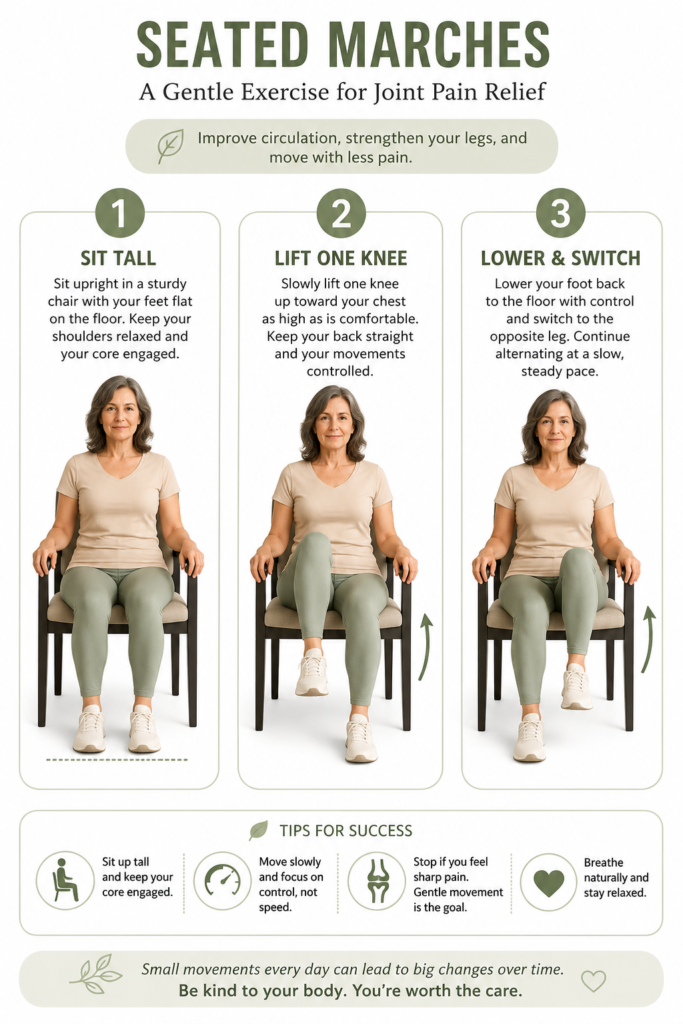
If mornings feel particularly rough — that deep stiffness when you first wake up and everything aches — this exercise is for you. Seated marches are a perfect beginner movement because they require zero weight-bearing and can be done right from your chair or the edge of your bed.
Sit upright in a sturdy chair. Slowly lift one knee up, lower it back down, then lift the other. That’s it. Alternate sides at a slow, controlled pace for 10 to 15 reps per leg.
Why they work:
- Activate the hip flexors and quadriceps without loading the knee joint
- Improve circulation in the lower body first thing in the morning
- Gently ease joint stiffness before you start putting weight through your legs
Think of it as warming up your engine before you drive. Your joints need a little coaxing in the morning — and seated marches are the gentlest way to give them that.
3. Gentle Hip Circles
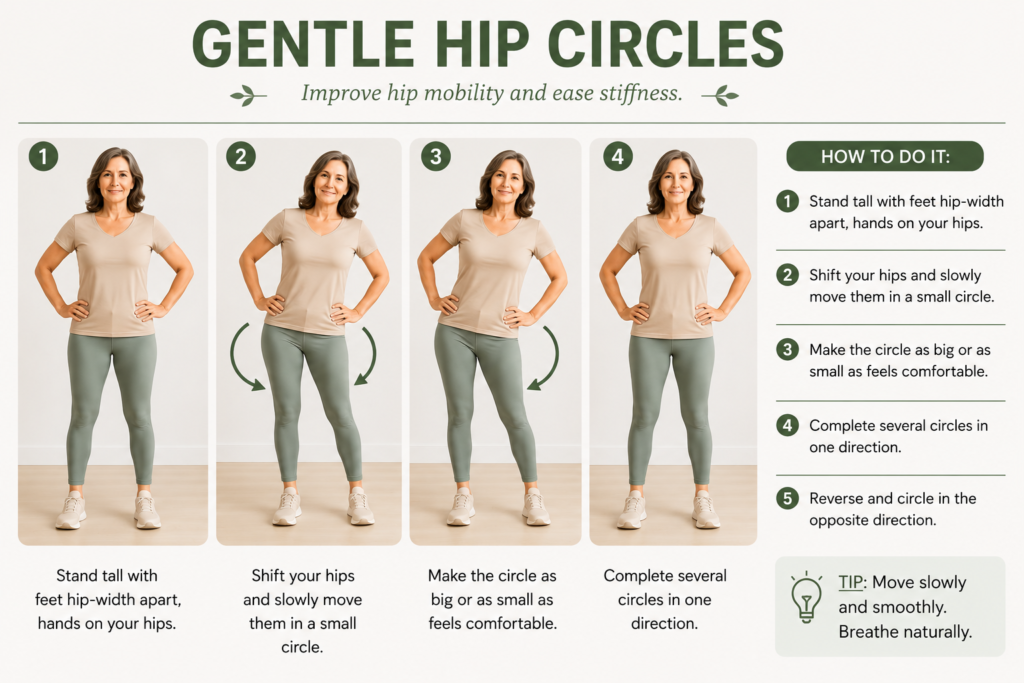
Here’s something that surprises a lot of people: many cases of knee pain originate in the hips. When your hip joints are stiff or restricted, your body compensates by shifting load to your knees — and that’s where the discomfort shows up.
Gentle hip circles target this directly. Stand near a wall or hold the back of a chair for balance. Slowly rotate one hip in a small, controlled circle — forward, out, back, and around. Keep the movement small and smooth. Do 5 circles in each direction, then switch sides.
Benefits of regular hip mobility work:
- Loosens the hip joint and surrounding connective tissue
- Improves balance and stability, which reduces strain on knees
- Supports better posture and everyday movement patterns
- Helps manage the stiffness that often accompanies joint inflammation
You might notice some clicking or popping in the hip — that’s usually synovial fluid moving, and it’s generally harmless. But sharp pain means stop.
4. Wall Push-Ups
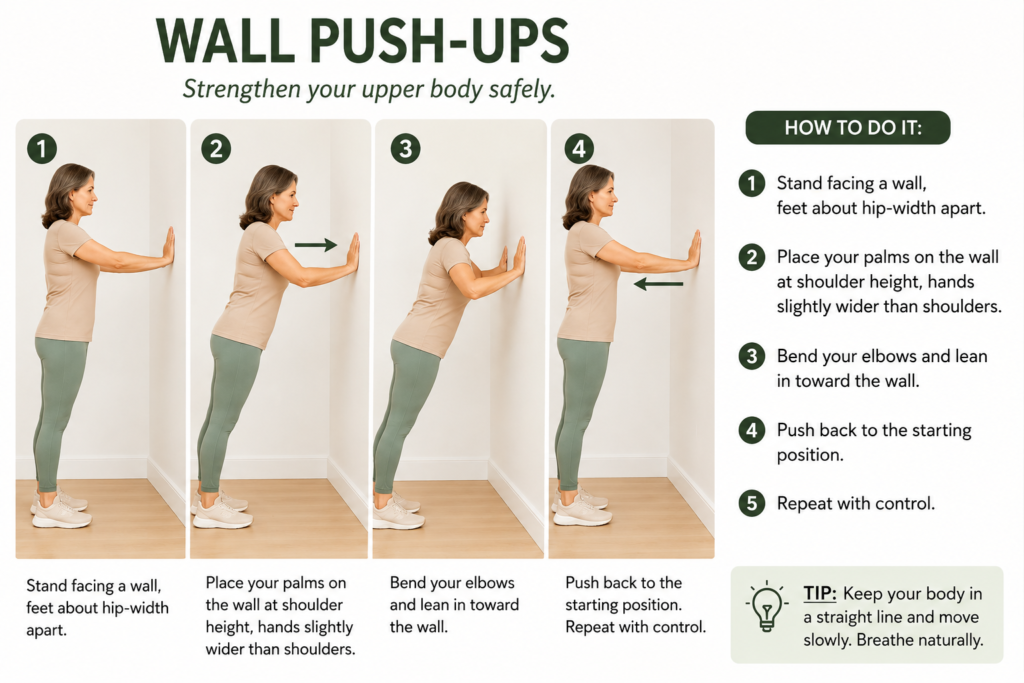
Don’t let the word “push-up” scare you off. This is nothing like dropping to the floor. Wall push-ups are a completely beginner-friendly way to build gentle upper body strength — and yes, that matters for joint health too.
Stand facing a wall, about arm’s length away. Place both hands flat on the wall at shoulder height. Slowly bend your elbows and bring your chest toward the wall, then push back to the start. That’s one rep. Aim for 5 to 8 slow, controlled reps.
Why wall push-ups belong in a joint pain routine:
- Build strength in the shoulders, arms, and chest without joint-loading floor work
- Improve posture, which reduces strain on the neck, upper back, and shoulders
- Engage the core gently, which supports overall stability and balance
As you get stronger, you can gradually move your feet further from the wall to increase the challenge. Small progressions, taken at your own pace.
5. Chair Sit-to-Stands
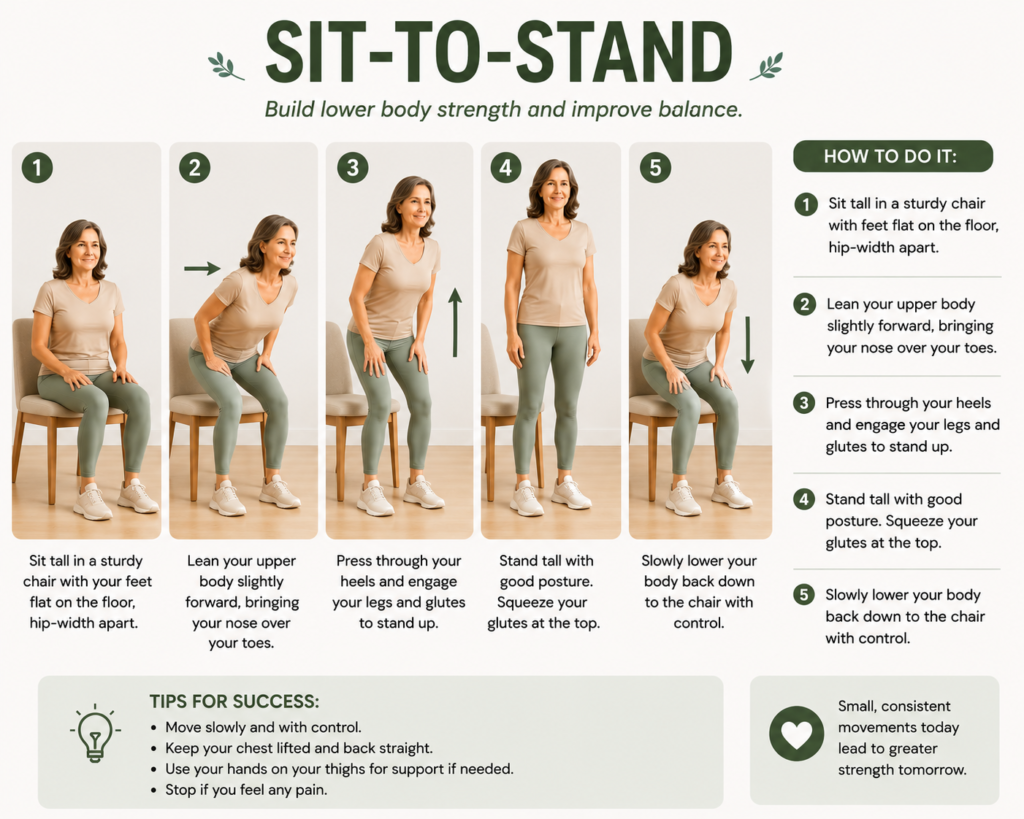
Out of all five exercises here, this one might have the most direct impact on your everyday life. The sit-to-stand movement — getting up from and lowering into a chair — is something most of us do dozens of times a day. When it becomes painful or difficult, it affects everything.
Sit at the edge of a sturdy chair. Cross your arms over your chest or extend them forward. Slowly stand up, pause briefly, then slowly lower yourself back down. Go as slow as you can on the way down — that’s where your muscles are working hardest.
What this exercise builds:
- Quadricep and glute strength — the muscles that protect your knee joints the most
- Functional movement confidence for everyday tasks
- Balance and coordination through a full lower body range of motion
Start with 5 reps. If that’s too challenging, it’s completely fine to use your hands on the armrests at first. The goal is controlled, pain-free movement — not perfection.
How to Put This Into Practice (Without Overdoing It)
One of the most common mistakes beginners make — especially when they’re finally feeling motivated — is doing too much too soon. One good day leads to a full workout, which leads to two days of soreness, which leads to giving up. Sound familiar?
Here’s a more sustainable approach:
- Start with 2 to 3 exercises per session, not all five at once.
- Do them on 4 to 5 days per week rather than every single day — your body needs rest to adapt.
- Keep sessions short at first: 10 to 15 minutes is plenty. You can build up gradually.
- Track how you feel the next morning — if you’re significantly more sore or stiff than usual, scale back slightly.
- Celebrate small wins. Getting up off the chair with a little less effort? That’s a win.
The goal right now isn’t transformation. The goal is to build a movement habit that your body can tolerate, enjoy, and want to continue. That’s the foundation everything else builds on.
“You don’t need to earn movement. You don’t need to be in peak condition to start. You just need to begin — gently, consistently, and with a little patience for yourself.”
A Note on Inflammation and Movement
If you’re dealing with a condition that involves chronic inflammation — like rheumatoid arthritis, osteoarthritis, or similar — you might wonder whether exercise is safe during a flare-up. The honest answer is: it depends, and it’s worth discussing with your doctor or physiotherapist.
What we do know is that gentle, consistent movement, done in the right way, is one of the most well-supported strategies for long-term inflammation support. It helps regulate inflammatory markers in the body, maintains joint mobility, and prevents muscle loss that can make joint pain worse over time.
The key word is gentle. The exercises in this guide are chosen specifically because they’re appropriate even for people with significant joint sensitivity. But if you’re in the middle of a severe flare, rest is valid too. Movement and rest aren’t opposites — they work together.
Always keep your healthcare provider in the loop, especially if you’re managing a diagnosed condition. These exercises are a starting point, not a treatment plan.

Ready to Start? Here’s Your Next Step
You don’t need a gym. You don’t need a perfect schedule. You don’t need to wait until you feel “ready” enough.
Pick one exercise from this list — just one. Do it today. Do it again tomorrow. That’s how every meaningful movement journey begins.
If this guide helped you, the next step is to watch the full video walkthrough, where I demonstrate each of these movements in real time, talk through what to watch for, and show you exactly how to modify it if something doesn’t feel right.
And if you want more guidance on building a gentle, sustainable movement routine that works with your body — not against it — make sure you’re subscribed. The next post goes deeper: we’ll cover what to do on high-pain days, how to adapt your routine as you get stronger, and which everyday habits are quietly making joint stiffness worse.
You’ve already done the hardest part. You showed up and you read this far. That’s not nothing — that’s a beginning.