
If your knees ache climbing stairs, your hips feel stiff every morning, or your hands hurt opening a jar — this is for you.
You are not imagining it. And you are not alone.
The problem is: most of the advice out there for joint pain is making things worse, not better. Below are the 5 science-backed mistakes that keep women over 40 stuck in pain — and exactly what to do instead.
“Your joints don’t have to hurt forever. But the fix starts with knowing what’s actually causing the pain.”
Mistake #1: Avoiding Weight Training Because You’re Afraid It Will Hurt
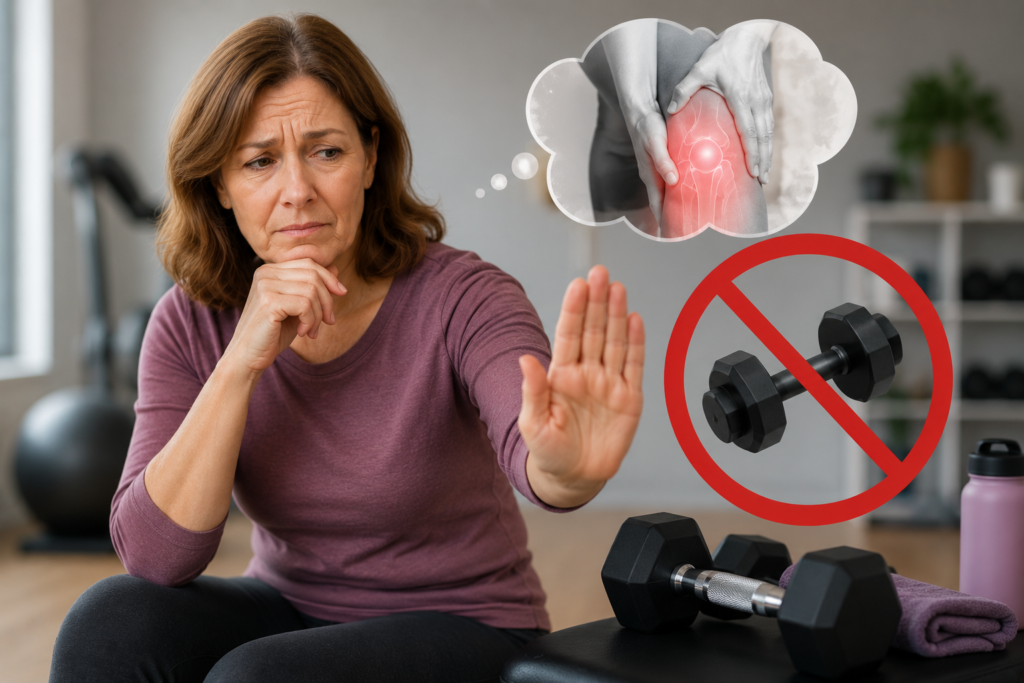
This is the most damaging myth in women’s fitness right now.
It makes sense to be cautious — if your knees already ache, adding weight sounds scary. And honestly, I understand why so many women believe it. When your knees already hurt, the idea of adding weight can sound scary. But here’s what the science actually shows:
- A study in the Journal of Rheumatology showed:
▶ Strength training reduced knee joint pain by up to 40% in women over 40 — Arthritis & Rheumatology. That’s more than anti-inflammatory medication.
▶ Women who did resistance training twice a week had measurably thicker, healthier cartilage after 12 weeks — Journal of Rheumatology.
Why does this work? Cartilage has no blood supply. It feeds through movement and gentle compression. When you avoid loading your joints, you’re starving them.
“Movement is medicine. The goal is the RIGHT kind of movement — not no movement”
Build Into It Safely: 3 Phases
- Phase 1 (Weeks 1–3): Wall sits, glute bridges, leg extensions with no weight. Wake up the muscles first.
- Phase 2 (Weeks 4–6): Partial squats (only 45°), step-ups on a low step. Bodyweight only.
- Phase 3 (Week 7+): Light resistance bands, goblet squats, Romanian deadlifts. Now you’re strengthening joints.
Mistake #2: Not Connecting Your Joint Pain to Perimenopause
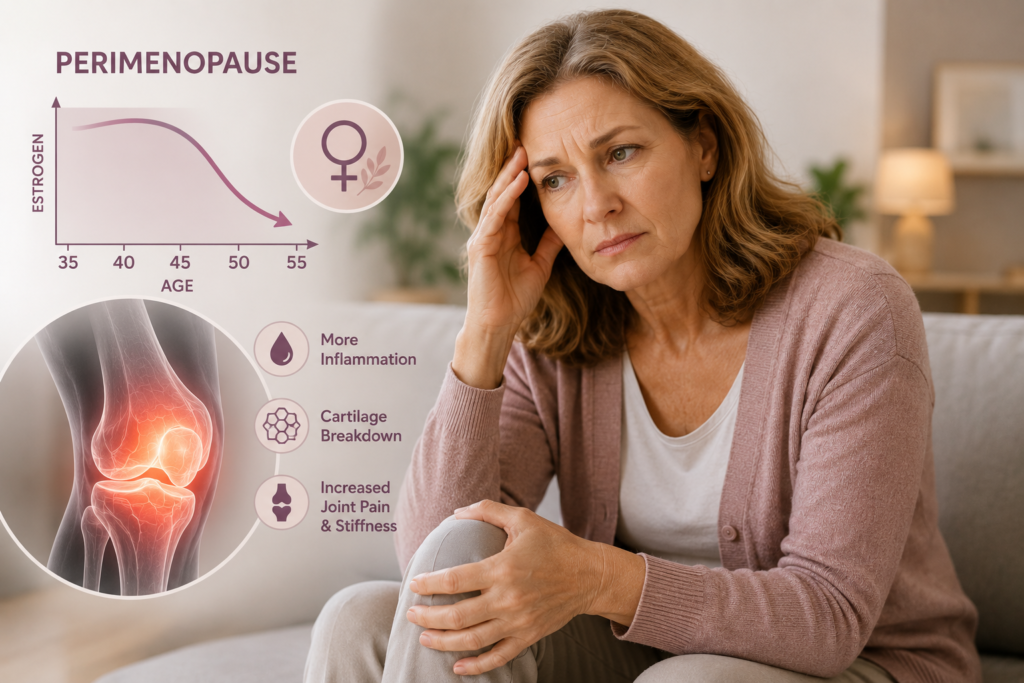
Most women are told joint pain is “just aging.” That’s incomplete — and it leaves women without real answers.
The real culprit for many women over 40 is declining estrogen.
Estrogen receptors live inside your joint cartilage. When estrogen drops in perimenopause, cartilage breaks down faster and joint fluid becomes more inflamed. This is published in Rheumatology International and backed by dozens of studies.
This is why your joint pain may have felt like it came out of nowhere in your 40s. It wasn’t random. It was hormonal.
“Perimenopause joint pain is real, it’s biological, and it responds to the right support.”
What Helps
- Protein: Aim for 1.2–1.6g per kg of body weight daily. Muscle is your joint’s shock absorber. (Source: Nutrients, 2022)
- Collagen + Vitamin C: Take 30–60 minutes before exercise. Research shows this measurably boosts collagen synthesis in joint tissue.
- Talk to your doctor: The research on estrogen therapy and joint health is strong. It’s worth a real conversation.
Mistake #3: Only Moving in One Direction
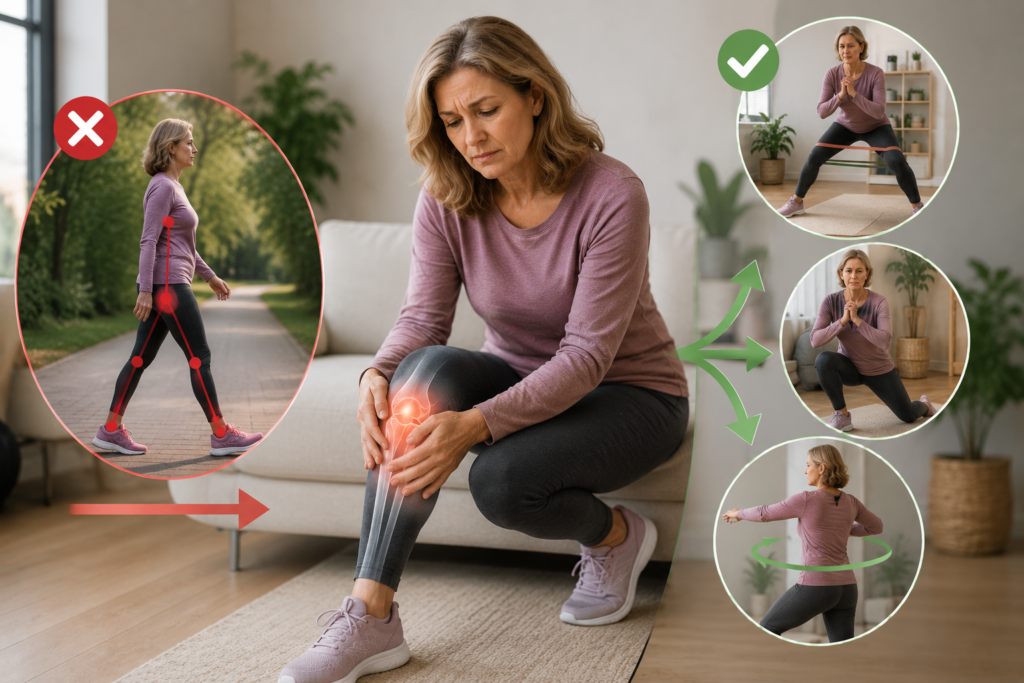
Walking, cycling, basic squats — these only move your body forward and backward.
But your joints move in three planes. When you never train sideways or rotational movement, the stabilizer muscles weaken — and weak stabilizers mean painful, unstable joints.
▶ Multi-planar training reduced knee instability and pain by 52% in 8 weeks vs. 18% for standard training — Physical Therapy & Rehabilitation Journal, 2021.
“Strong joints need to be strong in every direction — not just straight ahead.”
Easy Moves to Add
- Side steps with a resistance band — strengthens the hip muscles that keep your knee tracking properly.
- Curtsy lunge (bodyweight first) — trains rotational hip stability without stressing the knee.
- Standing hip circles holding a wall — gentle, joint-friendly, keeps the hip’s full range alive.
Mistake #4: Not Giving Your Joints Time to Actually Rebuild
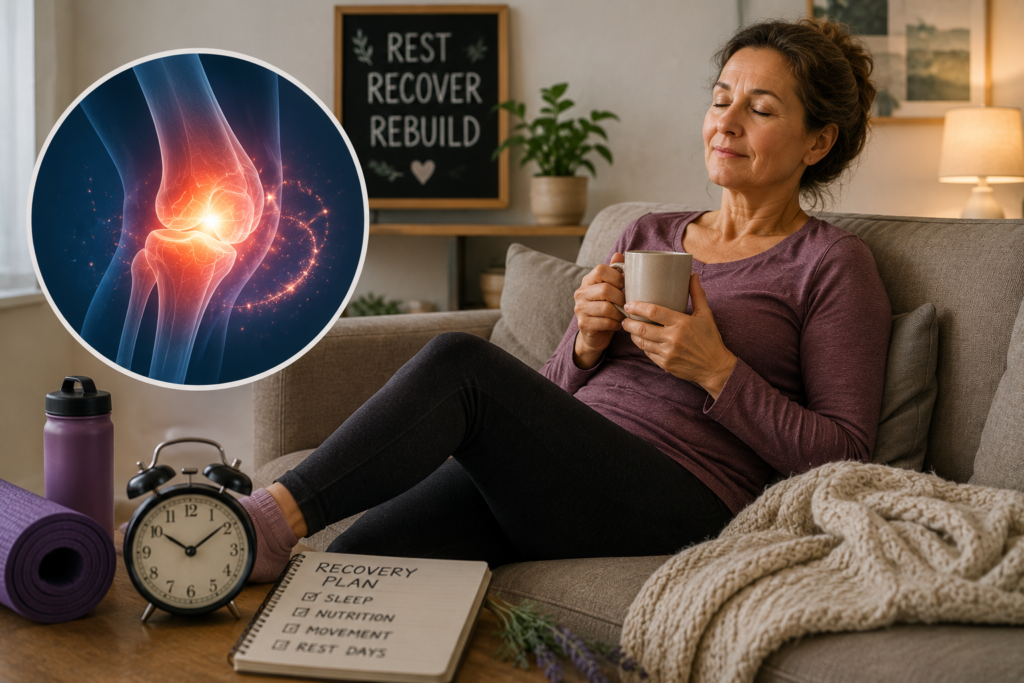
Here’s what most fitness content doesn’t tell you:
“Joints don’t get stronger during exercise. They get stronger during recovery.”
And after 40, that recovery window is longer. Research in Sports Medicine (2020) confirms women over 40 need 48–72 hours between sessions targeting the same joint — not 24.
Recovery Mistakes to Stop Making
- Skipping sleep: Growth hormone — which repairs joint tissue — is released during deep sleep. Under 6 hours raises inflammation markers.
- Skipping the cool-down: Just 5 minutes of gentle movement after exercise flushes synovial fluid and clears inflammation.
- Using ice on chronic pain: Ice is for acute injuries. For chronic joint pain, heat is better — it increases blood flow to tissue.
- Low omega-3 intake: 2–3g of EPA/DHA daily measurably reduces joint stiffness. (Source: Annals of the Rheumatic Diseases)
Mistake #5: Treating All Joint Pain the Same
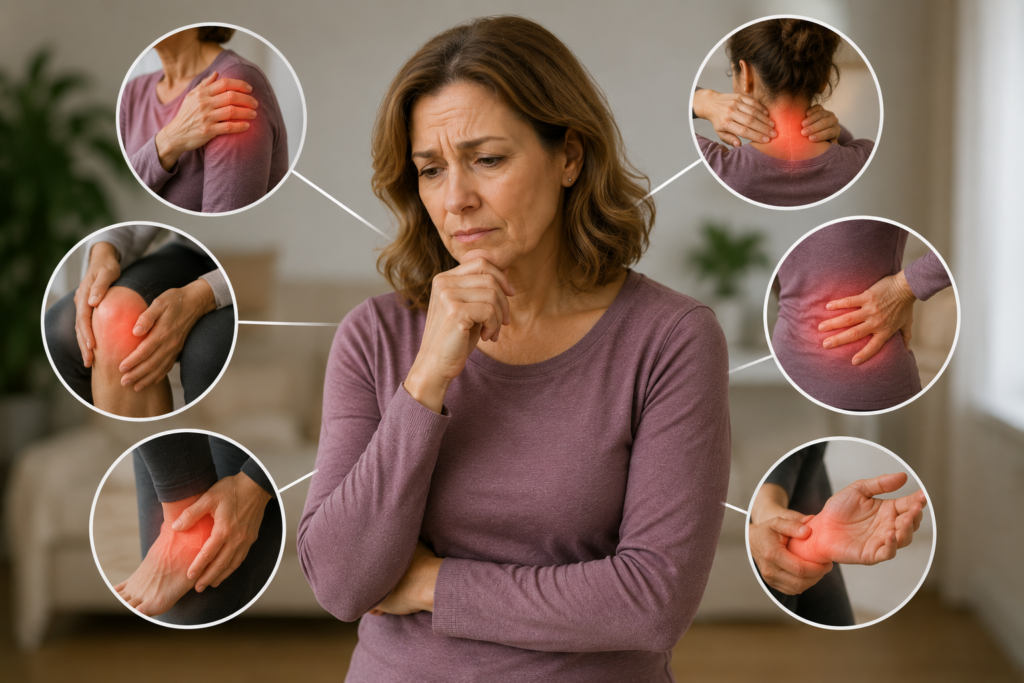
Not all joint pain is arthritis. Not all of it means stop moving. But treating all pain the same is one of the biggest reasons women stay stuck.
There are 3 types — and they need different approaches:
- Mechanical pain: Caused by muscle weakness or imbalance. Most common. Responds best to targeted strength training. Often felt at the front of the knee or outer hip.
- Inflammatory pain: Driven by hormones and immune activity. Signs: morning stiffness lasting 30+ minutes, warmth, swelling. Needs anti-inflammatory nutrition and gentler movement on bad days.
- Structural pain: Cartilage or bone changes. Exercise still helps (even with osteoarthritis!) — but exercise choice matters much more.
“Knowing what TYPE of pain you have changes everything about how you treat it.”
Quick Recap: 5 Mistakes to Leave Behind
- Stop avoiding weight training. Your joints need load to stay healthy.
- Connect your joint pain to perimenopause. It’s hormonal — not just aging.
- Add side-to-side and rotational movement. Strong in every direction.
- Respect your recovery. Sleep, space sessions, use heat, take omega-3s.
- Know your pain type. Mechanical, inflammatory, or structural each need a different approach.
Ready to Start Building Stronger, Pain-Free Joints?
The women in these research studies didn’t have special genetics or unlimited time. They just started — gently, consistently, and with the right information.
Your action plan this week:
- Not sure where to start? Begin with our guide: 5 Gentle Exercises That Help With Joint Pain — a beginner-friendly routine designed to help reduce stiffness, improve mobility, and support your joints without overwhelming your body.
- Pick ONE exercise from Mistake #1’s Phase 1 list and do it twice this week.
- Add collagen + vitamin C to your morning routine before movement.
- Leave a comment and let me know which mistake surprised you the most — and what joint pain challenge you’re struggling with right now. Your question may inspire the next article in this series.
You don’t have to do everything at once. One step. This week.